AI Use Cases in Industry: Where to Start to…

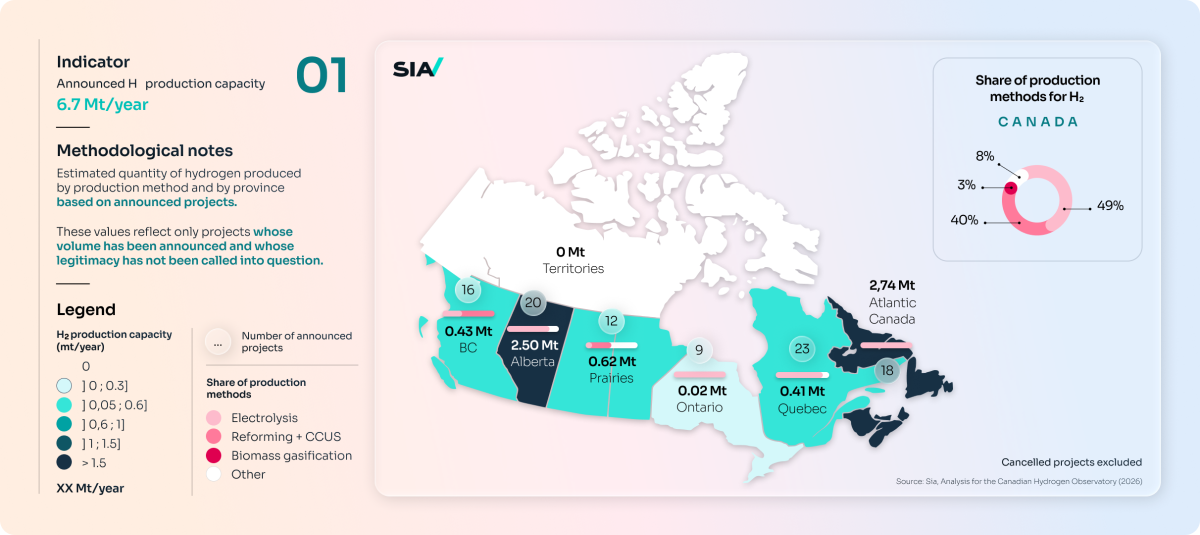
With 103 announced projects and 6.7 Mt/year of projected low-carbon hydrogen (H₂) production capacity, Canada maintains its ambition to become a major producer of low-carbon H₂. But the sector is entering a more demanding phase, with delays and dormant projects multiplying.

This third edition of the Canadian Hydrogen Observatory analyzes the projects identified as of July 31, 2026, along with their end uses, the resources they require and their economic benefits. With three years of data, it tracks the progress of each project and identifies what moves the sector forward, and what holds it back.
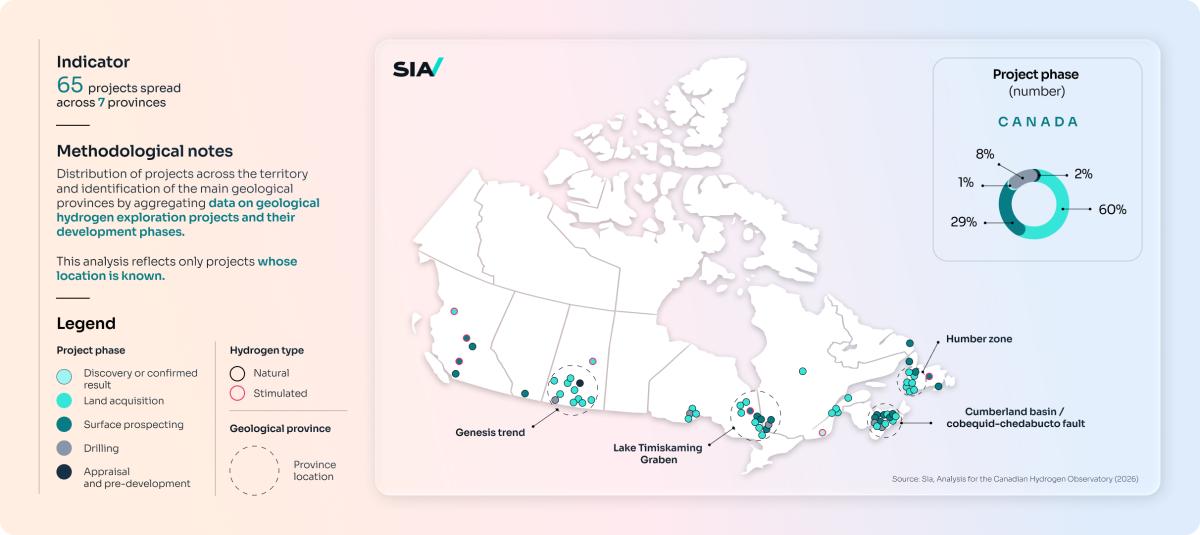
This year, it adds two new sections: an overview of hydrogen equipment manufacturers in Canada, and a first snapshot of geological hydrogen.
Since 2025, 10 new projects have been announced, and total planned production has risen from 6.55 to 6.72 Mt/year. This increase comes mainly from existing projects that have revised their ambitions upward: the 25 projects announced since 2024 add up to only 197 kt. Only one cancellation was recorded in 2025-2026. However, 20 projects (2.3 Mt) are behind schedule, and 25 projects (1.3 Mt) have shared no information for more than a year. Of the 98 production projects, 18 are operational, but they account for only 7% of announced capacity.
Globally, announcements are undergoing a second downward revision: the pipeline of projects to 2030 has fallen from 37 to 27 Mt/year, according to the International Energy Agency. At the same time, actual production is accelerating: about 1.2 Mt of low-carbon hydrogen is expected in 2026, which is more than 1% of global H₂ production for the first time.
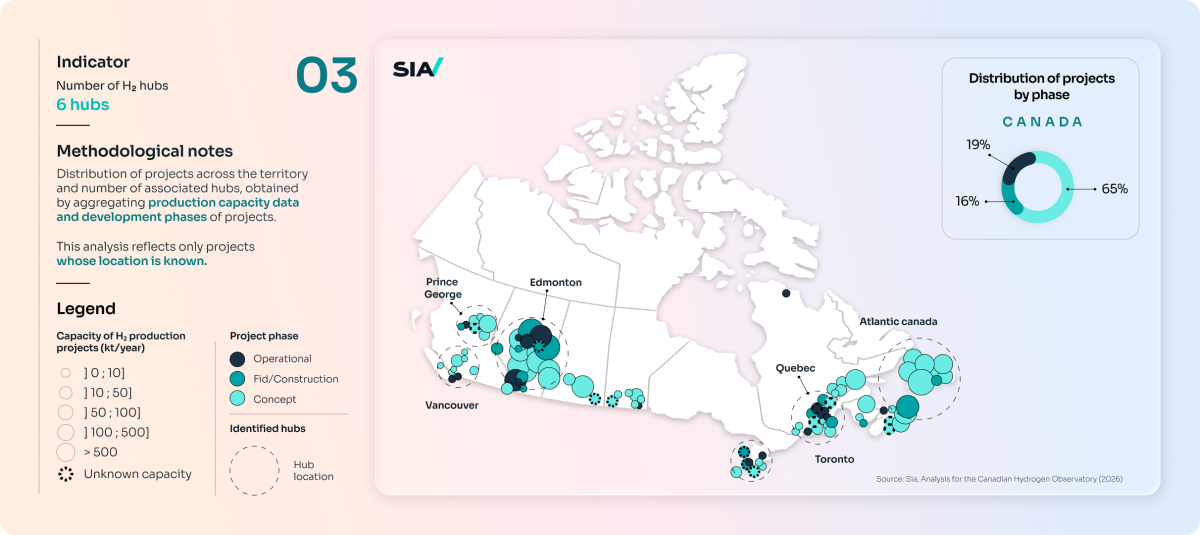
Synthetic fuels account for 78% of the 6.0 Mt/year of earmarked consumption. This is mostly ammonia for export, to Europe from Atlantic Canada and to Asia from the West. The remainder is split between steel (11%), petrochemicals (8%) and, on a much smaller scale, mobility, grid injection and other industrial uses. The Observatory still identifies 6 H₂ hubs: Prince George and Vancouver in British Columbia, Edmonton in Alberta, Toronto, Quebec City and Atlantic Canada.
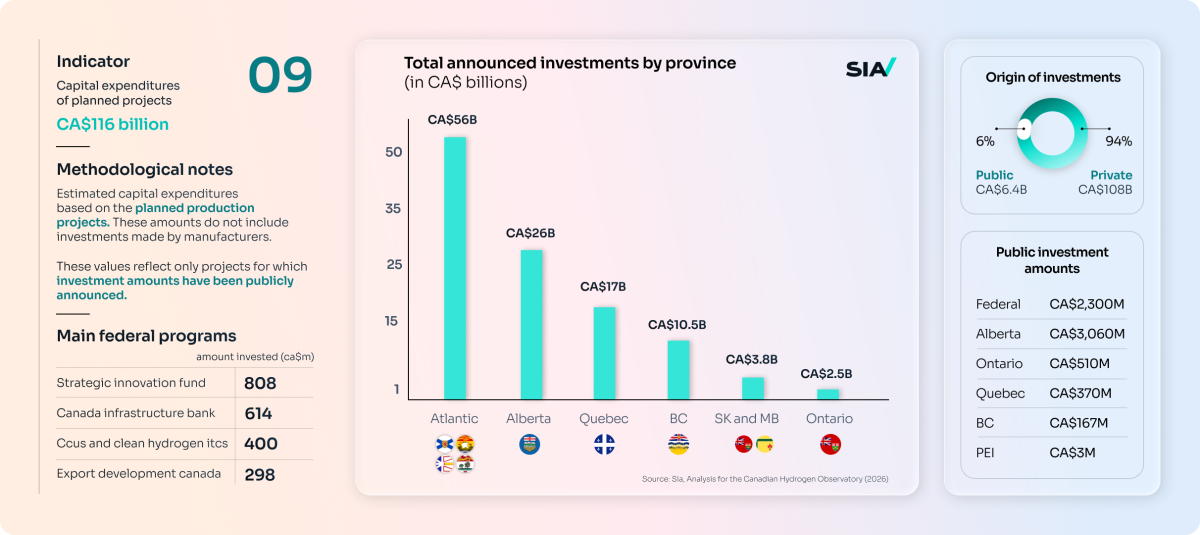
Announced investments in production projects reach CA$116 billion, compared with CA$104 billion in 2025. Of this total, CA$113 billion relates to projects that are not yet operational. Funding remains 94% private.
Public support is unevenly distributed. The Maritimes account for nearly half of announced investments (CA$56 billion), yet public support there represents less than 1% (CA$393 million). Quebec, by contrast, received CA$628 million for CA$17 billion of investment. For new projects announced in 2025, the public share falls below 1%. Yet delays are largely explained by rising CAPEX, access to electricity and tariffs on equipment.
Export-oriented projects would represent CA$26.8 billion, close to 3% of Canada’s 2025 exports, including CA$18.3 billion for low-carbon ammonia.
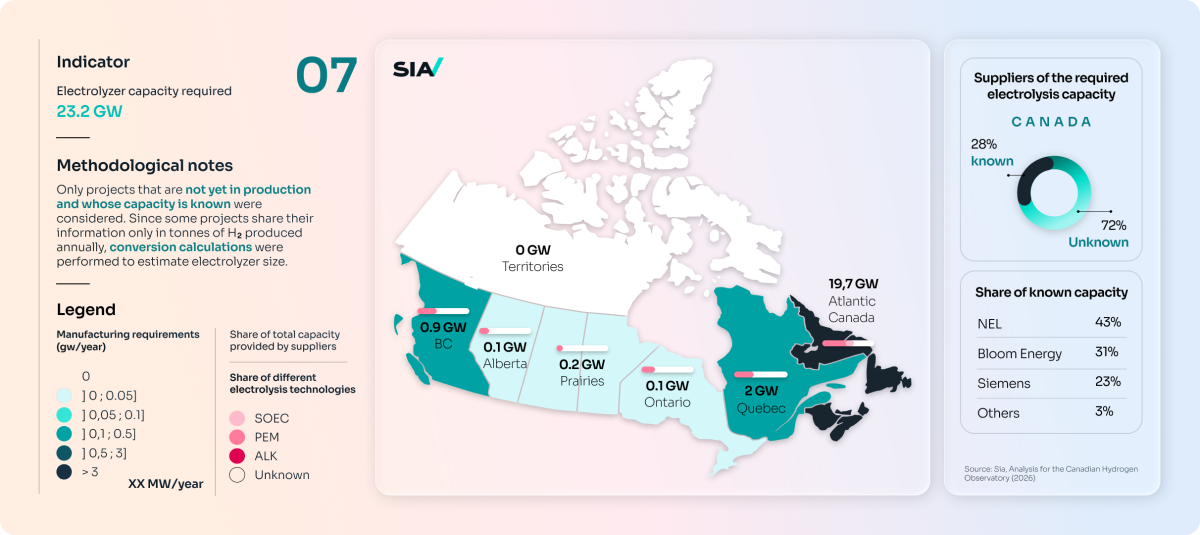
Delivering all of the projects would require 194 TWh/year of electricity (179 TWh in 2025), 183 hm³/year of water (155 hm³ in 2025), 23.2 GW of electrolyzers (20.6 GW in 2025) and 73,900 t of critical minerals (71,800 t in 2025).
Atlantic Canada accounts for 77% of electricity requirements, more than twice its current capacity. Lack of access to blocks of low-carbon electricity has already contributed to project stoppages, such as Coyote in British Columbia and Teal Chimie & Énergie in Quebec. On the critical minerals side, Canada produces no iridium, lanthanum or yttrium, and refining remains concentrated in China and South Africa.
No supplier has yet been announced for 72% of the electrolyzers required, leaving room for Canadian and foreign manufacturers.
The country already has about forty hydrogen equipment manufacturers, with distinct regional profiles:
British Columbia: about twenty manufacturers, historically structured around fuel cells.
Prairies: an Alberta-based ecosystem focused on H₂ storage and heavy-duty mobility.
Eastern Canada: about a dozen manufacturers, centred in Ontario around electrolyzers.
For the first time, the Observatory identifies 65 geological hydrogen exploration projects across 7 provinces. They are concentrated in four geological areas: the Genesis Trend in Saskatchewan, the Lake Timiskaming Graben in Ontario and Quebec, the Humber Zone in Newfoundland and the Cumberland Basin in Nova Scotia.
The sector remains at a very early stage: nearly 90% of projects are at the land acquisition or surface prospecting stage, and only 5 have reached the discovery stage. Exploration overwhelmingly targets natural hydrogen rather than stimulated hydrogen.
Managing Partner Canada | Montreal
Patrick Robert is a Montreal-based Managing Partner leading the Canada market. With over 25 years of consulting experience, he oversees the Financial Services, Public Sector, and HR & Transformation practices, supporting clients in large-scale transformation initiatives.