Driving circular performance: defining and…

The global museum landscape has more than tripled since 2015. The next challenge is no longer expansion alone, but ensuring institutions have the capabilities, funding models and operating systems to convert cultural assets into lasting public value.

Museums are moving beyond their traditional role of collecting, conserving and exhibiting heritage. They are increasingly expected to support tourism, education, community engagement and economic development. Yet these expectations are rising as operating conditions become more demanding: across 15 UK national museums, costs increased 18% in real terms between 2021–22 and 2024–25, while attendance remained 13% below pre-pandemic levels.
Yet despite significant capital investment in new buildings and expanded collections, a fundamental question persists: are museums truly equipped to operate as the public platforms, cultural engines, and global attractions that stakeholders now expect them to be?
The answer is that museums stand at an inflection point. While the foundations of museum practice, in the form of collections stewardship, conservation, and scholarly research, remain strong, the real opportunity now is building the operational readiness that will carry that momentum into lasting institutional impact.
The numbers tell a compelling story. UNESCO estimates that the number of museums worldwide increased from around 31,000 in 2015 to more than 104,000 by 2023. Iconic institutions such as the Musée du Louvre, the National Museum of China, and the British Museum each attract millions of visitors annually. In the GCC alone, the UAE welcomed over four million museum visitors in 2023, while Qatar and Saudi Arabia are rapidly expanding their cultural infrastructure.
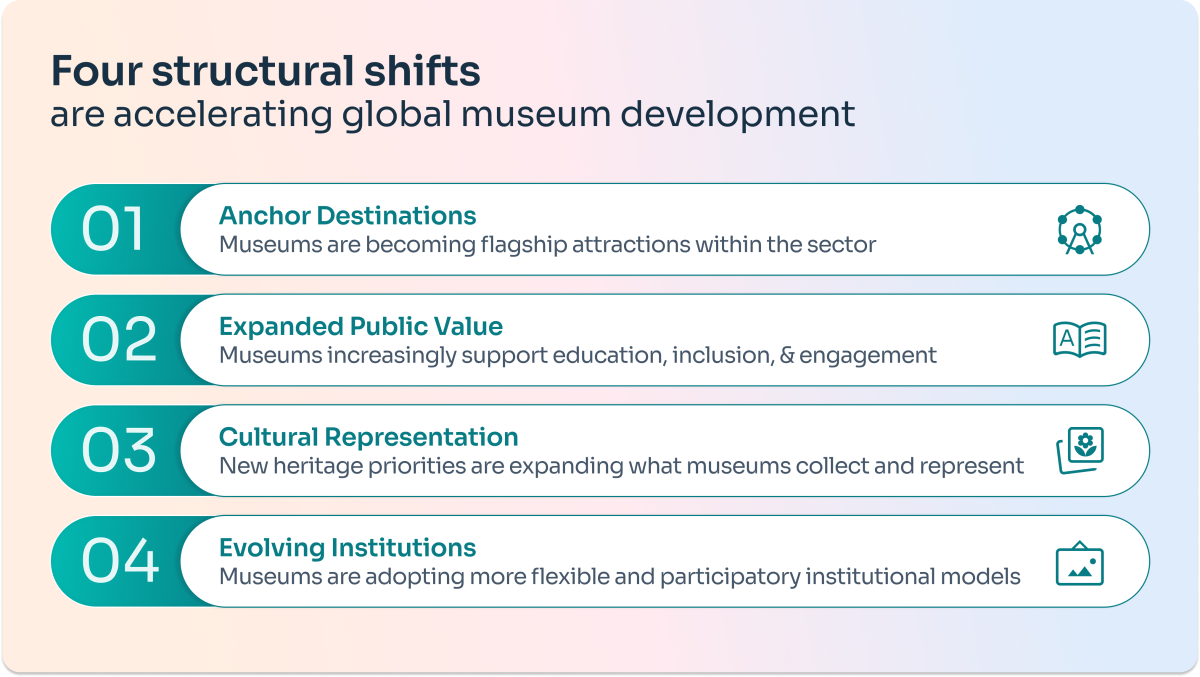
Museums are increasingly becoming anchor destinations. A 2025 German study estimated that nearly 7,000 museums generated €9.4 billion in economic value added, illustrating how museum activity supports tourism, employment and local economies beyond institutional revenues. Second, their public value is expanding. Museums are increasingly assessed not only through attendance, but through learning, inclusion, wellbeing and community outcomes. Recent UK research also demonstrates measurable value among non-visitors who value the preservation and future availability of museum collections. Third, cultural representation is evolving. Provenance, restitution, local heritage and community participation are reshaping what museums collect, interpret and how they engage with the communities they represent. Finally, museums are becoming more adaptive institutions. Funding pressure, digitalisation, sustainability requirements and new audience expectations require more flexible governance, capabilities and financing models.
But growth alone does not guarantee impact. The institutions that will thrive in the coming decade are those that can translate scale into strategy.
These structural shifts translate into seven operational priorities: experience, personalisation, hybrid engagement, cultural representation, financial resilience, sustainability, and technology & AI.
Technology will accelerate change, but it is an enabler rather than an end state. The institutions best positioned to benefit will be those with strong collections data, clear governance, relevant skills and sustainable operating models.
The implication is clear: the next frontier of museum development is institutional readiness the ability to translate investment into sustained cultural, social and economic impact.
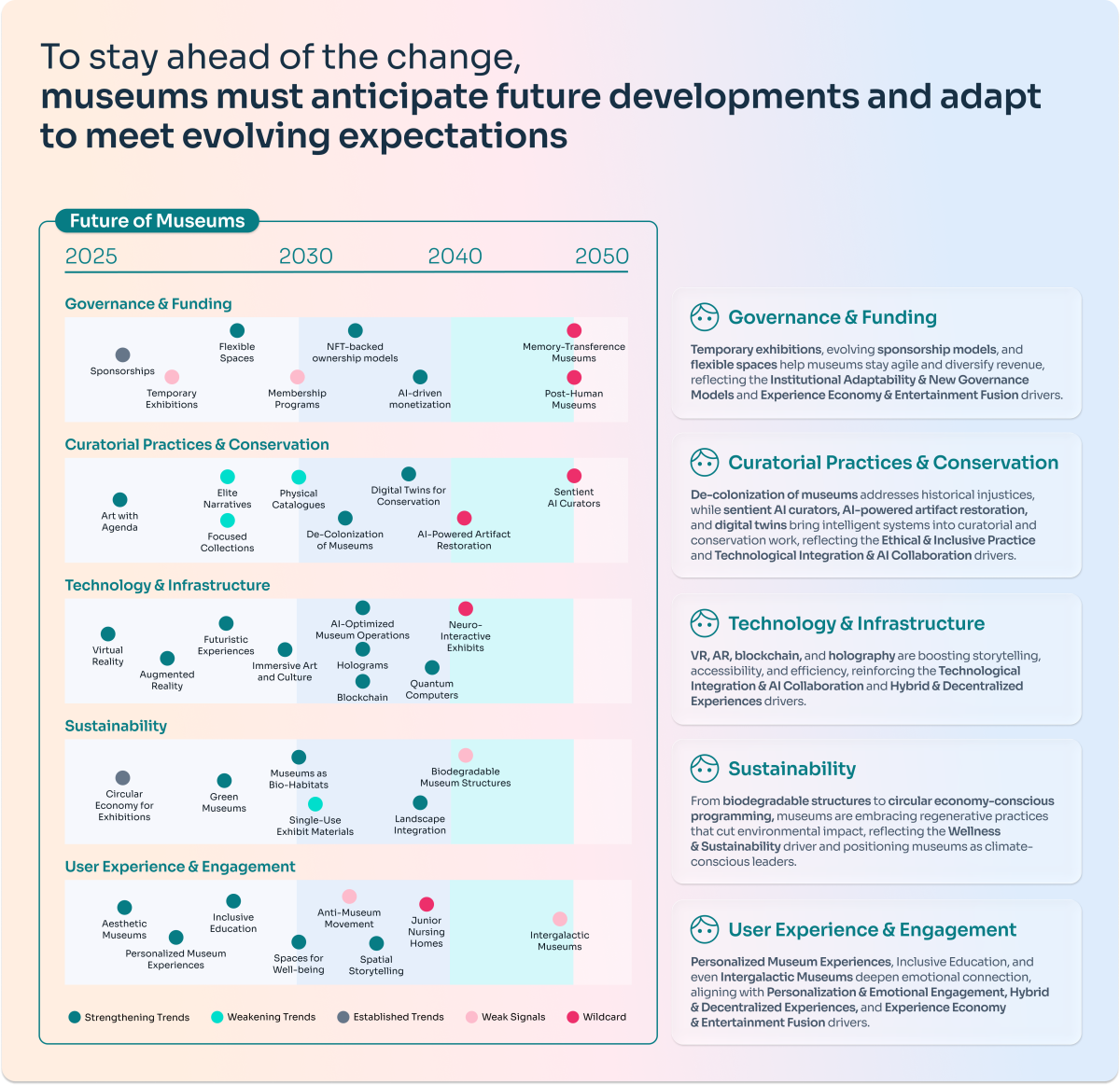
To remain relevant and resilient, museums are rethinking their organizational structures. This includes experimenting with decentralized governance, cross-sector partnerships, sponsorships and collaborative ecosystems. These shifts support innovation, workforce development, and the ability to respond quickly to emerging challenges.
Audiences increasingly expect immersive, emotionally resonant encounters. Museums are blending education with theatrical storytelling, gamified learning, and interactive exhibitions to attract broader demographics and generate new revenue streams. This shift supports financial sustainability and positions museums as dynamic cultural destinations rather than static institutions.
With visitors increasingly expecting personalized, emotionally resonant experiences, museums are leveraging data, AI, and immersive technologies to tailor content to individual preferences and learning styles. This is transforming passive viewing into interactive storytelling and active participation, fostering deeper connections and building public trust, especially among younger and more diverse audiences.
The traditional museum model is expanding beyond physical walls. Digital platforms, mobile exhibitions, and urban installations allow institutions to engage audiences wherever they are, reduce overhead, and increase accessibility. This decentralization allows museums to remain relevant in a world where cultural consumption is increasingly mobile and on-demand.
AI is reshaping every aspect of museum operations, from personalizing tours, moderating content, and simulating historical figures to digitizing collections and enabling predictive conservation, while AR and VR create entirely new, immersive forms of cultural expression. These innovations, however, demand robust digital infrastructure and great attention to cybersecurity.
Growing pressure to address historical injustices and operate with greater transparency, including repatriation of looted artifacts, diversification of curatorial voices, and transparency in acquisitions, is reshaping how museums earn and maintain public trust. Ethical and inclusive practices not only align with global movements for justice but also mitigate reputational risk and strengthen institutional credibility.
Museums are positioning themselves as contributors to personal and planetary well-being through green building practices, climate-focused programming, and wellness-oriented experiences such as mindfulness tours and nature-based installations. By aligning with sustainability goals and promoting resilience, museums position themselves as ethical and future-ready institutions.
Synthesising the industry’s growth trajectory with the trend drivers reshaping it, four realities will determine institutional readiness over the next decade. Considered together rather than in isolation, they indicate where investment should be prioritised and which capabilities museums must build to keep pace with the industry's evolution.
Collections Stewardship and Digital Access
Core collections management, conservation, and scholarly research capabilities remain well established across the sector. The next priority is disciplined documentation, paired with the digitalization and broader release of collection registries to researchers, so institutions can unlock scientific value and support global knowledge exchange.
From Custodianship to Public Engagement
Institutions are shifting from custodianship to public engagement, with exhibition design, interpretation, and accessibility working together to convert scholarly knowledge into experiences that resonate with a broader public.
Financial Maturity and Sustainability
Having been built on substantial public investment, museums must now progress toward financial maturity, balancing sustainable operating models with the premium standards required to attract major collections, collectors, and international loans.
AI as Cross-Cutting Enabler
Embedding AI across the museum ecosystem is now essential for keeping pace with the sector's trajectory — from smarter collections cataloguing and predictive conservation on the back-end, to multilingual guides, conversational interfaces, and personalised content on the front-end. Institutions that move early will compound advantages across both operations and experience, while those that delay risk falling behind on efficiency, relevance, and visitor expectations simultaneously.
Together, these four realities point to where museum leaders should focus first: closing the readiness gap identified above, sequencing investment across governance, experience, and technology, and building the internal capability to sustain momentum once the initial wave of growth levels off.
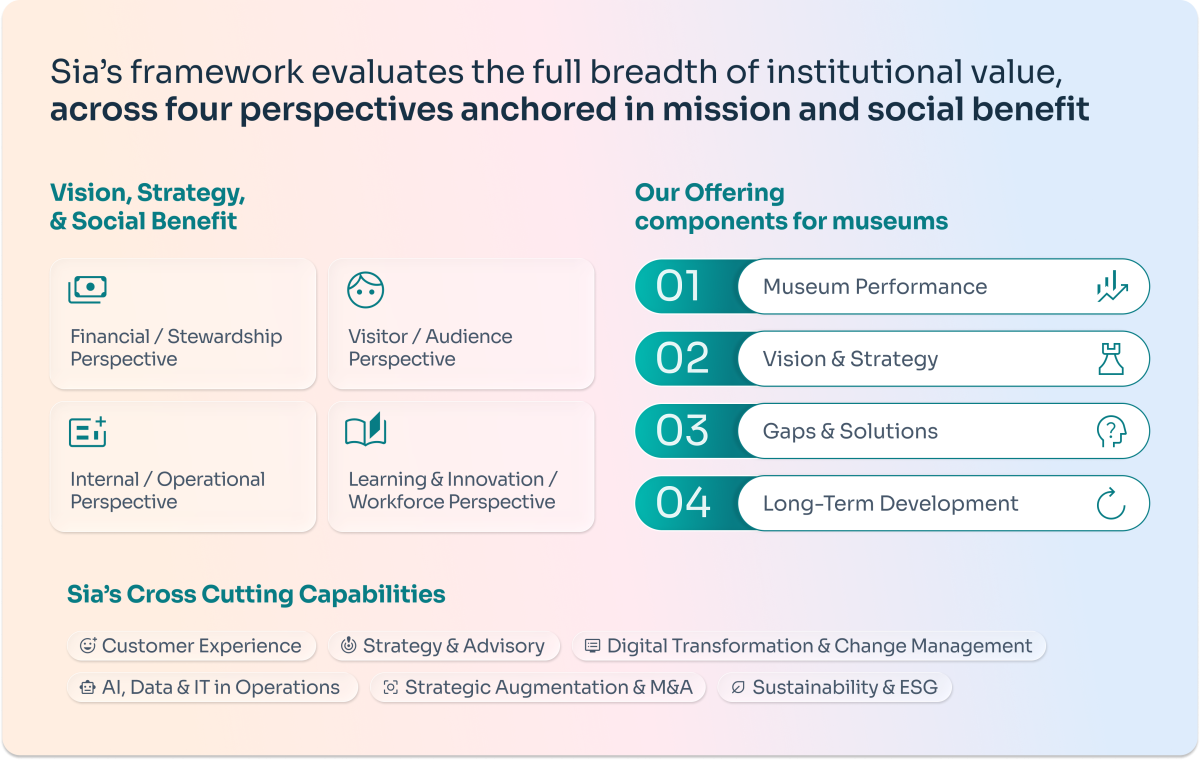
Sia supports museums across every stage of its end-to-end value creation model. Our framework provides a phased methodology to assess, reposition, and strengthen museum institutions in alignment with their cultural mission and long-term sustainability.
A structured, AI-enhanced diagnostic across four dimensions (financial stewardship, visitor and audience engagement, internal operations, and workforce capability) and benchmarked against global and regional peers. The result is a comprehensive scorecard with maturity levels and actionable KPIs.
Alignment of leadership around a shared mission, strategic positioning, and cultural narrative. Sia helps institutions define their future identity, establish strategic pillars, and set measurable outcome targets that translate purpose into direction.
Identification and prioritization of capability and performance gaps across the museum value chain, translating strategic ambition into actionable priorities. Sia designs targeted solutions across operations, collections, exhibitions, and customer experience, and defines the operating model, governance, and organizational enhancements needed to close them.
Embedding strengthened capabilities into institutional systems through capability-building programs, partnership and funding strategies, sustainability frameworks, and scalable performance monitoring, ensuring that transformation endures beyond the engagement.
Across all four perspectives, Sia brings cross-cutting expertise in customer experience, strategy and advisory, digital transformation and change management, AI and data operations, sustainability and ESG, and strategic augmentation, supported by a best-in-class ecosystem of technology and delivery partners.
Associate Partner, UAE
Patrick is an Associate Partner based in the UAE, advising dynamic organizations on strategic growth through foresight, innovation, and economic cluster development, with a focus on tourism and the culture and creative industries.