The Workforce Ahead: Designing and Planning for…

Agentic AI is shifting cost from headcount to tokens, and jobs are too coarse a unit to plan around. Sia helps organizations redesign work around tasks and skills and govern AI spend with the same rigor as headcount, so the workforce can adapt before costs force the decision.

Organizations that will be AI-competitive will redesign work around the tasks that agentic AI can absorb, which means rebuilding the enterprise workforce around skills and capabilities rather than functional jobs. What is new in the equation is that organizations must govern the resulting AI cost trajectory with the same discipline as headcount, before that spending surge forces the workforce planning decision for them.
Agentic AI is reshaping which roles exist, how work is priced, and where cost sits inside the enterprise. At the same time, AI itself is getting more expensive to run at scale: token use is projected to grow 24 to 70 times its current volume by 2030, driven mostly by autonomous agents.1
The opportunity is significant: Sia estimates that a $1 billion revenue organization can generate between $5 million and $100 million in annual value as it moves from broad GenAI adoption to fully institutionalized agentic capabilities.2 Capturing it means managing work through skills and capabilities rather than fixed jobs, so talent can shift as needs change. The question is no longer whether to adopt AI, but whether the workforce can adapt fast enough.
AI does not affect every role the same way, and that difference is the best planning signal available. Where AI can absorb most of a role’s tasks, the role tends to shrink. Where it absorbs only part, people move into the higher-value work that remains and the role tends to grow.3 Forward-thinking leaders are inventorying each role’s tasks and skills required, measuring how much AI can be absorbed, and designing around the answer. Because absorption differs task by task, the job is too coarse a unit to plan around. Skills and capabilities can move as tasks change, so they become the basis for planning, hiring and development.
Most organizations are not there yet. Real AI use sits well below what is technically possible,4 because roles have not been redesigned around it. Exposure also reaches higher than many expect: the most exposed workers tend to be better paid and more highly educated.5
Broad employment effects are not yet visible across the labor market,6 but early signals are. Entry-level hiring into AI-exposed roles has already slowed,7 and gateway roles such as customer service and administrative support now lead into exposed career paths.8 Rebuilding around AI means rebuilding the career ladder, not just replacing the bottom rung. Cost is the next pressure point.
Forecasts of AI usage have repeatedly come in too low.9 Budgeting from last year’s AI spend means planning for a trajectory the market has already passed.
The driver is not just more users. Agentic workflows use far more tokens per task than a chatbot exchange.10 Price per token keeps falling,11 but volume per task is growing faster, so AI is not reducing enterprise cost, it is moving it from headcount to software and token spending.12 Exhibit 1 shows the two forces pulling in opposite directions.
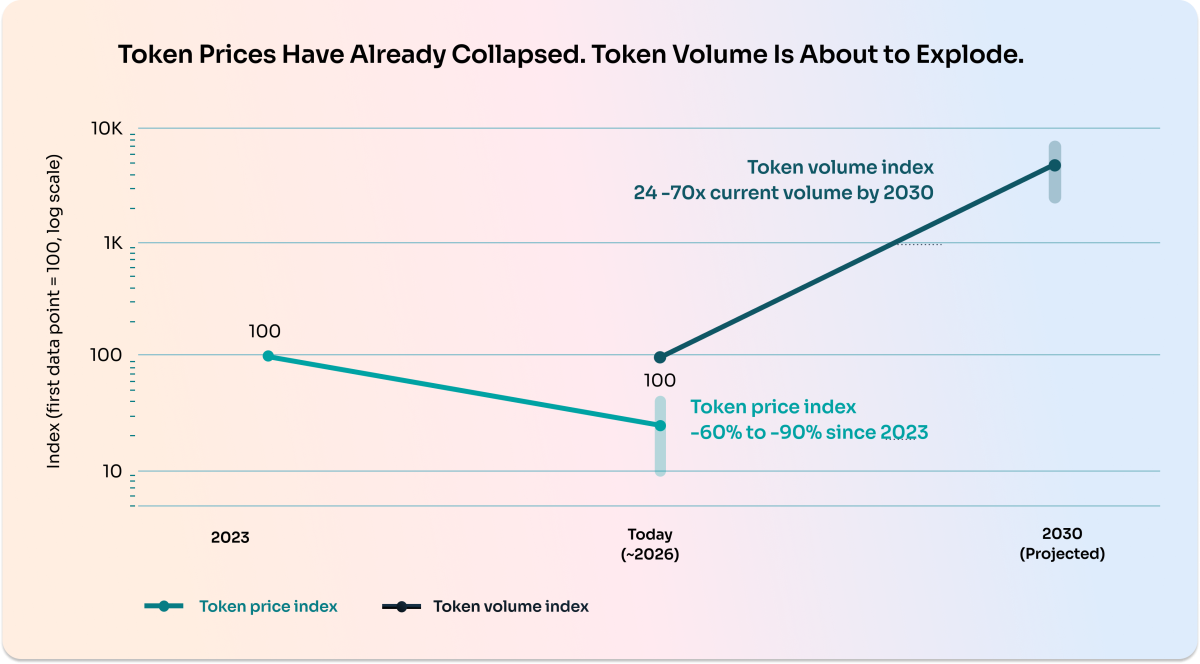
Exhibit 1. Token prices are indexed from 2023; token volume is indexed from today. Ranges reflect the low/high estimates sourced, not a single point forecast. Sources: notes 1, 10, 11.
Cutting headcount does not end the cost of disruption. It returns later, often larger, as rehiring premiums and a lasting premium for AI-skilled talent whose skills date quickly.13 Table 1 shows where each cost lands.
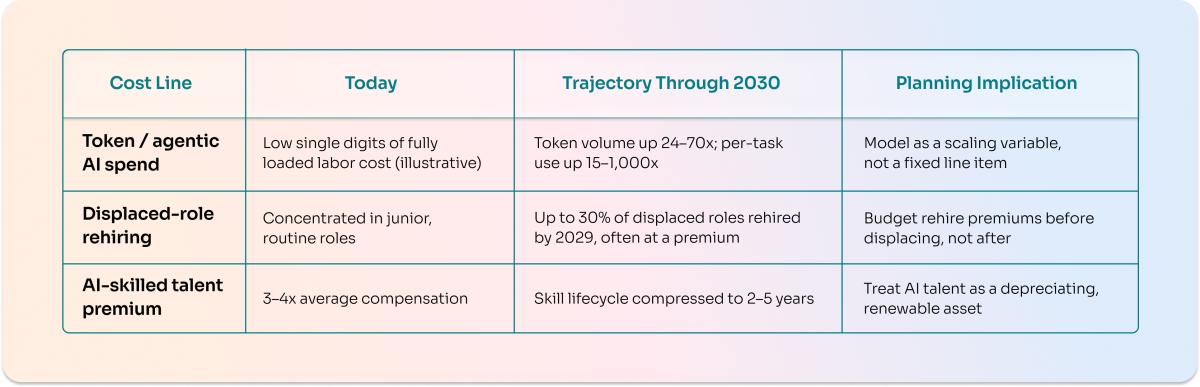
Table 1. Where workforce-related AI costs land and how they are expected to move through 2030.
Today, AI and token spend is a small share of total workforce cost, but the trajectory is the strategic issue. AI usage is on a steep growth path,14 while workforce costs rise only a few percent a year,15 so AI spend is climbing much faster than the headcount cost it is meant to offset.16 Exhibits 2 and 3 show the lines diverging and the resulting shift in cost share. Organizations that model this gap now will not be surprised in the near term.
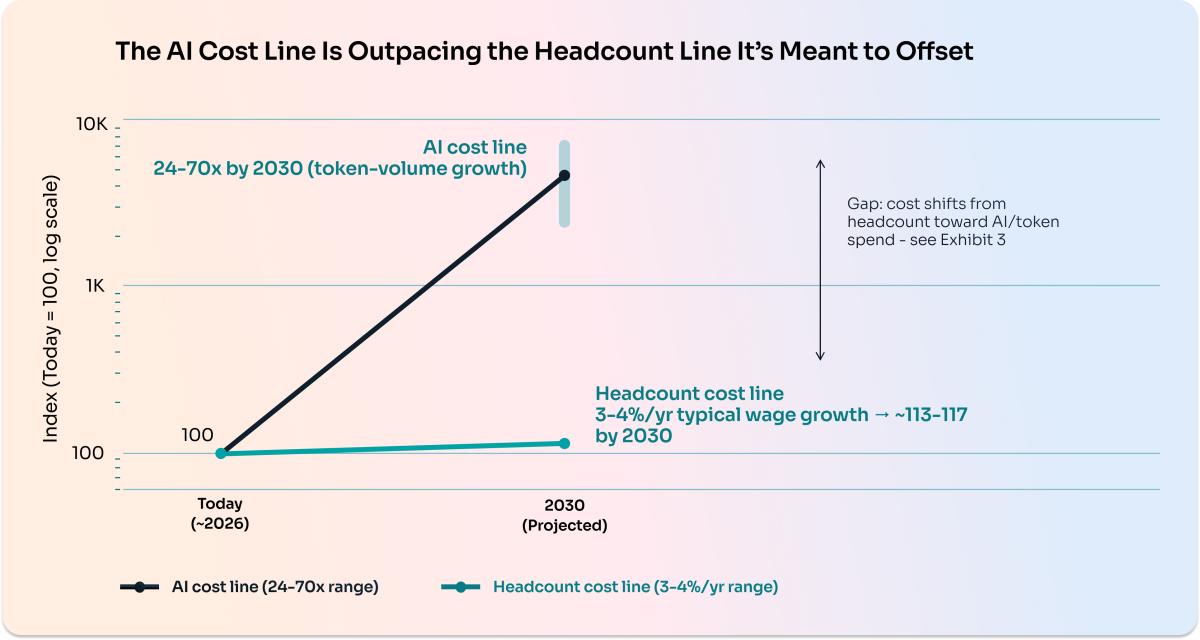
Exhibit 2. AI cost line reflects the sourced 24–70x token-volume growth range (note 1) and does not net out falling per-token prices. Headcount cost line reflects an illustrative 3–4%/year wage-growth range (note 15). See Exhibit 3 for the cost-share view.
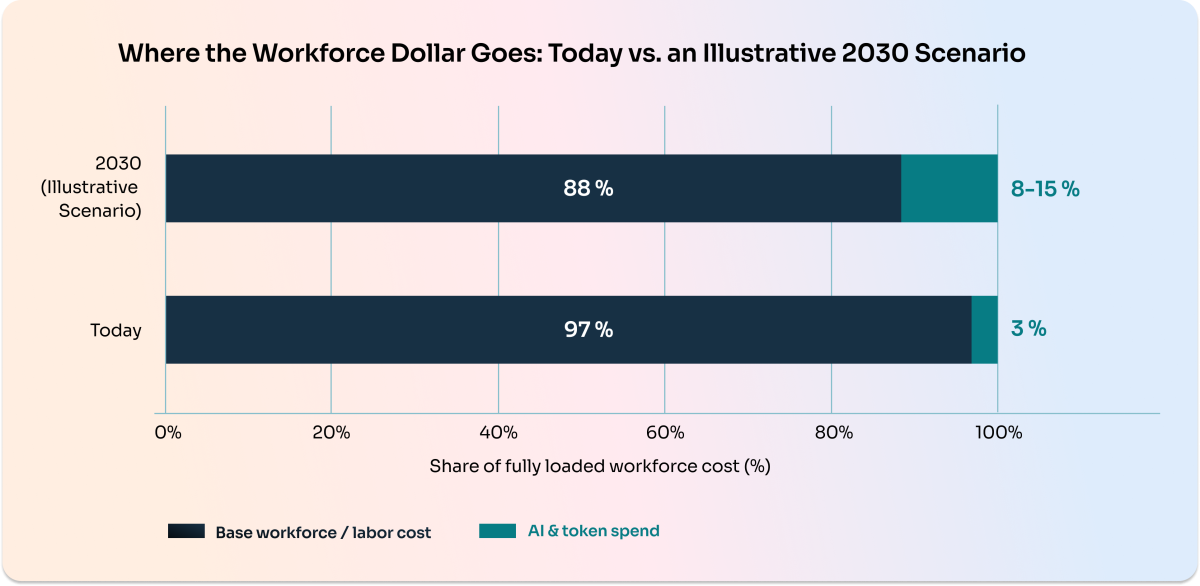
Exhibit 3. Source: Sia analysis (see note 16). "Today" is Sia’s illustrative estimate of AI and token spend as a share of fully loaded workforce cost. The 2030 scenario is an illustrative planning range, not a forecast, and is deliberately conservative relative to the 24–70x range in Exhibits 1 and 2.
Sia’s 2025 benchmark of large organizations found that leaders feel ready for AI, but oversight is thin, many pilots are abandoned, and most report no bottom-line value yet. 17 Priority has outpaced value and closing that gap is the real workforce strategy problem.
Our point of view is that closing it starts with what the organization prioritizes, not which tool it adopts next. Leaders must decide where agentic AI creates value and rebuild the workforce around those priorities, rather than layering AI onto the existing organization.
Sia’s Human-Centered AI Integration Framework operationalizes that shift across 3 phases:
Optimizing the existing workforce and designing the future one are the same exercise, run on the same timeline, against the same data. Organizations that treat them separately leave workforce value unrealized.
Understanding how AI will change the workforce, and planning for it, matters most. Three points hold the argument together. Redesign work around tasks. Partial automation grows roles, full automation shrinks them, and exposure reaches higher-paid roles as much as routine ones. Rebuild around skills. Tasks shift faster than job titles, therefore skills are the unit organizations can actually move. Govern AI cost like headcount. Token costs compound faster than most models assume, and displacement costs return later through rehiring and skill obsolescence.
Set against that cost curve is a comparably large opportunity: between $5 million and $100 million in annual value for a $1 billion revenue organization.18 The organizations that win will not be the ones that adopt AI fastest. They will treat workforce planning and AI cost management as a single discipline, starting with a clear strategy for the workforce today.
Director | New York
Specialization leading large, global corporations through operating model transformation and organizational change leadership.

Partner, Head of Business Transformation, NA | New York
Diana is a Partner at Sia, where she leads the Business Transformation business unit for North America, with over 25 years of experience in business transformation, HR strategy, and change management for Fortune 500 companies.

Director | New York
People & Transformation Practice

1. Beth Kindig, "AI Token Demand Is Shattering Forecasts," I/O Fund, July 30, 2026, citing Goldman Sachs projections.
2. Sia AI Maturity & Value Realization model, illustrative estimate of annual value creation across four AI maturity stages for a hypothetical $1 billion-revenue organization; based on Sia’s internal benchmarking and client-engagement experience, not a published third-party study.
3. Lawrence D.W. Schmidt, Menaka Hampole, Dimitris Papanikolaou, and Bryan Seegmiller, as covered in "How Artificial Intelligence Impacts the US Labor Market," MIT Sloan, October 9, 2025.
4. Maxim Massenkoff and Peter McCrory, "Labor Market Impacts of AI: A New Measure and Early Evidence," Anthropic Research, March 5, 2026.
5. Massenkoff and McCrory, op. cit., note 4.
6. Neale Mahoney, Erika McEntarfer, and Karsen Wahal, "What is Really Happening to Jobs? Separating AI Hype from Reality," Stanford Institute for Economic Policy Research, Policy Brief, July 2026; and The Budget Lab at Yale, "Tracking the Impact of AI on the Labor Market," updated September 15, 2026.
7. Massenkoff and McCrory, op. cit., note 4; and Erik Brynjolfsson, Bharat Chandar, and Ruyu Chen, "Canaries in the Coal Mine? Six Facts about the Recent Employment Effects of Artificial Intelligence," Stanford Digital Economy Lab, November 2025.
8. "AI and the Workforce: Impacts on Jobs, Workers, and Employers," Bipartisan Policy Center, Issue Brief, April 22, 2026.
9. Tirias Research, cited in Kindig, op. cit., note 1.
10. Kindig, op. cit., note 1, citing Anthropic and Stanford University research; Iternal Technologies, "Token Usage Guide 2026," July 12, 2026.
11. Iternal Technologies, op. cit., note 10.
12. Jan Bansch and Joe Coyle, "AI Isn’t Reducing Workforce Costs — It’s Reshaping Them," Gartner, June 1, 2026.
13. Bansch and Coyle, op. cit., note 12.
14. Kindig, op. cit., note 1.
15. Mercer, "2026 Salary Budget Snapshot," reported via WorldatWork, "Mercer Forecasts 3.5% Total Salary Increase Budgets for 2026," September 3, 2025 (1,157 U.S. compensation leaders surveyed); cross-checked against WTW, "2026 U.S. Salary Increase Budgets Will Hold Steady at 3.5%," reported via WorldatWork, July 8, 2025 (1,569 U.S. organizations surveyed), and other major 2026 U.S. compensation surveys reported alongside it (WorldatWork, Gallagher, Payscale), which range from roughly 3.2% to 3.6% for 2026 projected budgets, with actual 2025 increases running as high as 4.0% at some firms. Sia rounds this to an illustrative 3–4%/year planning range.
16. Sia analysis comparing the sourced 24–70x growth in AI token volume (note 1) against the typical 2026 wage-growth range above (note 15); a directional planning comparison, not a measured industry average. It does not net out falling per-token prices (note 11). The 15–1,000x per-task token multiplier (note 10) would widen this gap further if included.
17. Sia benchmark of 50+ large companies across 7 industries, conducted 2025.
18. Sia AI Maturity & Value Realization model, op. cit., note 2.