Digitally Wired: How Distribution System…
With millions of solar and wind assets nearing end of life, the question is no longer if, but how to act now. Sia analyzes markets, regulations, and technologies to help a diverse range of companies turn this challenge into a source of value, resilience, and competitive advantage.

In 2024, 585 GW of new renewable capacity was installed, bringing the total global capacity to 4,448 GW - an increase of more than 15% in one year.
Solar and wind power account for nearly 12% of global electricity production. This rapid growth affects all continents, with millions of installations in service, but raises a fundamental question:
“What to do with this infrastructure when it reaches the end of its life?”
Four paths are open to handle the end-of-life materials today, with very different impacts on the value chain.

Reuse and recycling represent the main levers for value creation and circularity. Energy recovery can play a complementary role, while landfilling remains the least sustainable solution and should be strictly minimized as it destroys material value, generates long-term environmental risks, and locks resources out of future use.
To better understand the sector’s challenges and the potential levers for action, it is essential to analyze the regulatory frameworks governing these practices in each region.
The main observation is that each region is moving forward at its own pace.
In Europe, strict regulatory frameworks already govern photovoltaics, notably through the Waste Electrical and Electronic Equipment (WEEE) Directive. In contrast, some regions are only in the early stages.
For wind power, current regulations remain more heterogeneous and future legislative evolutions will be decisive to anticipate obligations, costs, and opportunities.
In order to provide stakeholders with a clear and operational vision, we have identified and analyzed existing regulations by country and by type of installation:
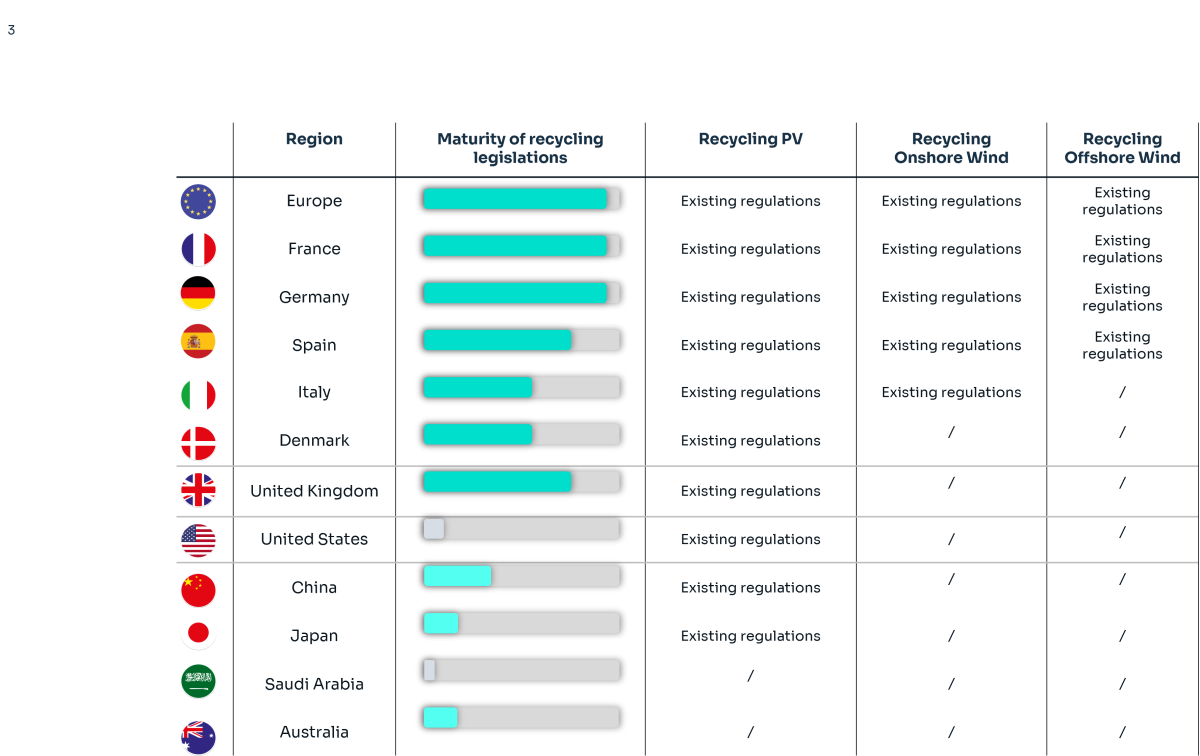
This regulatory mapping provides an essential basis for understanding regional dynamics.
It also sets the foundation for the analysis of waste deposits, which allows us to anticipate the volumes to be treated and translate them into concrete market opportunities.
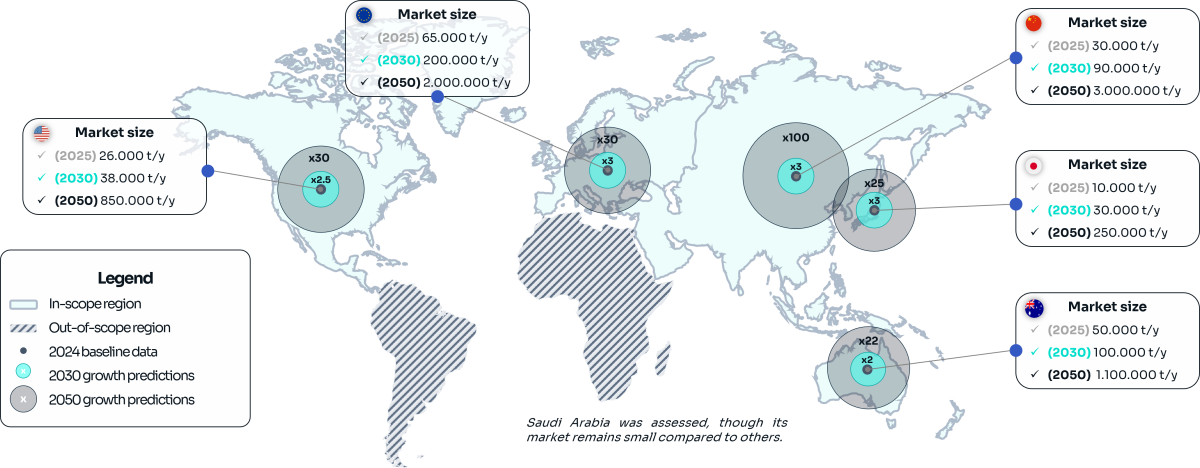
By 2030, and then 2050, the volumes of waste from solar panels and wind turbines are expected to increase sharply, raising growing challenges for the sector.
Several scenarios were examined by combining assumptions on the lifespan of photovoltaic panels and wind turbines with deployment dynamics specific to each region. This approach allowed us to estimate the volume and timing of waste generation and anticipate the size and location of future deposits. These projections are key to understanding how recycling and recovery markets will progressively structure themselves.
The various estimates studied indicate a volume of PV waste of around 500,000 tons/year in 2030 and 7 million tons/year in 2050.
To address these challenges, it is essential to understand the technical solutions available, assess their maturity and effectiveness, and their potential for large-scale deployment.
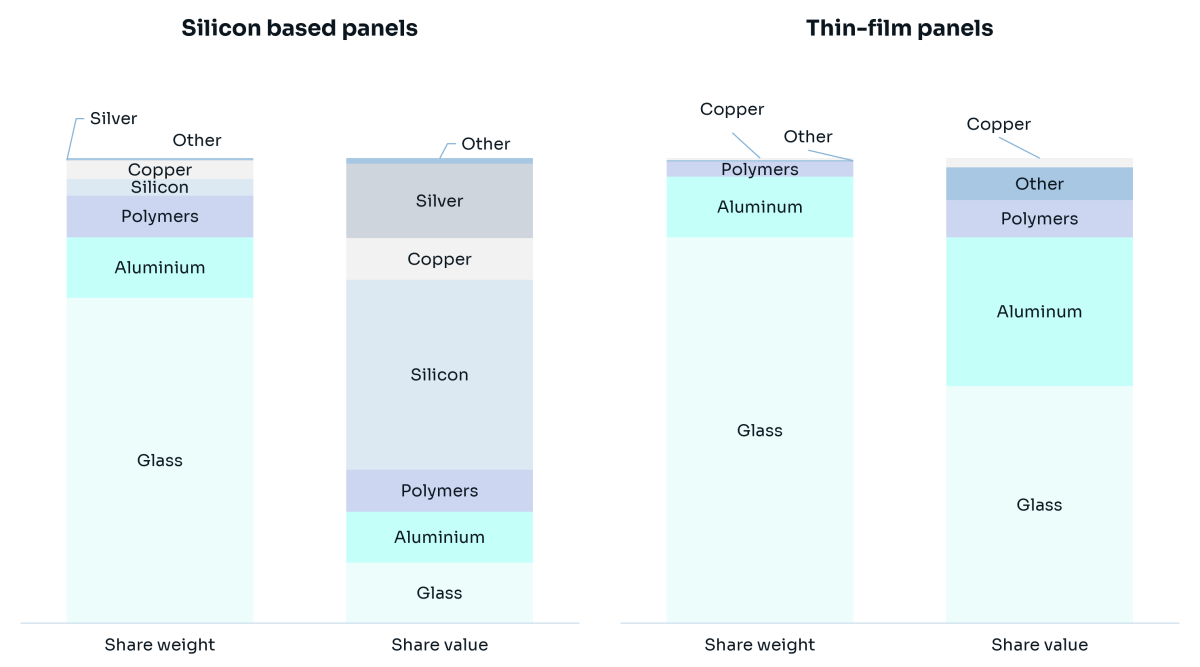
Solar panels and wind turbines rely on very different technologies but share a common challenge: the complexity of the materials they are made of; and the technical challenges of separating them to extract value.
Most existing recycling processes have limitations in terms of efficiency, cost, or purity of the recovered materials but emerging solutions are beginning to address these issues, paving the way for more sustainable treatments that can better handle future volumes.
Sia undertook a detailed analysis of the recycling technologies available for photovoltaics and wind infrastructure, as well as the technical specificities of these two sectors (equipment composition, key materials, and processing constraints) in order to assess opportunities for innovation and industrial structuring.
Beyond recycling itself, the broader challenges of reducing, reusing and recycling come into play. Exploring these alternatives highlights that end-of-life management is not limited to material recovery, but also includes options such as direct reuse and second-life applications.
Other options are developing for end-of-life equipment: direct second-hand reuse (for example, solar panels resold to individuals or for lower-power installations); the reconditioning of certain components such as inverters; or even the reuse of components in very different sectors (for example, wind turbine blades transformed into street furniture or integrated into construction).
Some initiatives also explore recycling in architectural, agricultural, and educational projects. These alternatives offer complementary outputs for extending the lifespan of materials and limiting environmental impact.
Based on the previous analyses, it therefore appears that the end-of-life phase of PV and wind installations can also represent an opportunity for value creation.
The management of PV and wind waste should not be seen solely as an environmental or regulatory constraint: it also represents an economic challenge, driven by the value of the strategic materials to be recovered and by the evolution of legal obligations, which are accelerating the structuring of the sectors.
Anticipating these transformations therefore allows operators not only to limit their risks, but also to capture new sources of value and secure their position in the markets of tomorrow.
Sia has developed unique expertise to support solar and wind energy players in managing the end-of-life of their installations. Thanks to a dedicated methodology, we help anticipate risks, assess costs, and identify opportunities. Our support covers a wide spectrum: navigating evolving regulations, designing and optimizing recycling and reuse channels, conducting market and technology benchmarks, building business cases, and supporting manufacturers, operators, and recyclers in the implementation of circular economy strategies. In doing so, we turn end-of-life challenges into drivers of competitiveness and innovation.
Our goal: to support you in transforming a challenge into a lever of value.
Managing Partner | Brussels
Jean is Managing Partner and Climate Analysis Global Lead at Sia Partners. In charge of several business units for global transformations related to Sustainability and low Carbon strategies, AI/DS, Risk, Pricing & Revenues Mgt, Innovation & Strategic Roadmap.