150,000 agents per company by 2028. Who is…

A study on the current state of mobile banking in the EMEA region, North America, Asia and Australia, and a peek into the future.

Mobile banking continues to move from a service channel to the core environment in which customers manage their relationship with their bank. Daily transactions remain essential, but expectations now extend much further: customers want to open and manage products, access support, monitor their finances and receive relevant guidance through a single, intuitive digital experience.
This transformation is taking place in a market shaped by several simultaneous forces. Technology is developing quickly, particularly in artificial intelligence and data-driven services. Customer expectations are rising, influenced by the simplicity and responsiveness of digital experiences in other sectors. At the same time, banks are operating under increased scrutiny regarding fraud prevention, accessibility, sustainability and the responsible use of technology.
For banks, the question is therefore no longer simply how many services are available in the app. The real challenge is to create an experience that is complete, easy to use and trusted, while remaining relevant throughout a customer’s financial life.
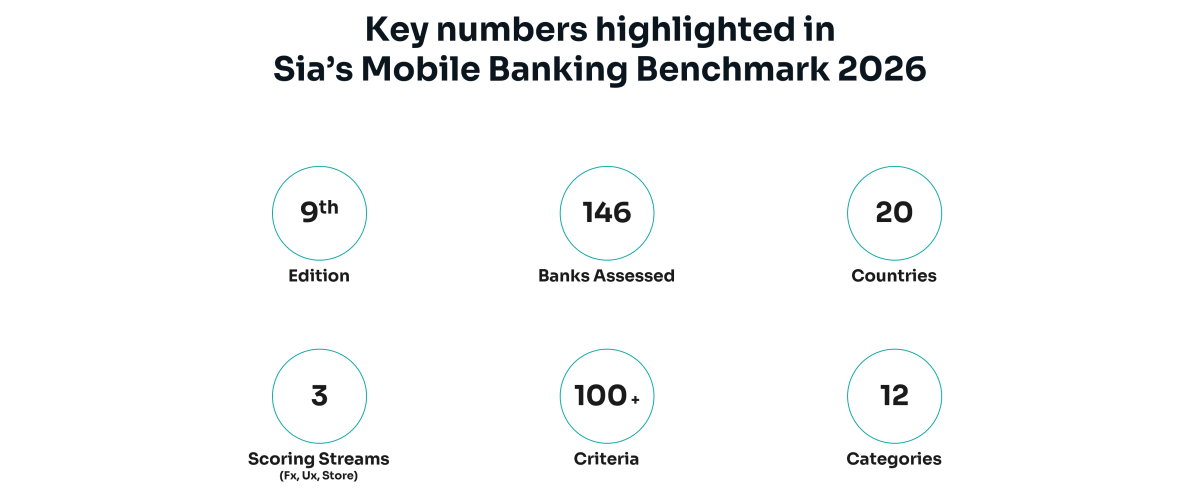
Sia’s 2026 International Mobile Banking Benchmark provides a global view of how banks are responding to this challenge. The ninth edition reviews 146 banking applications across 20 countries in EMEA, North America, Asia and Australia. More than 100 criteria are assessed through three complementary perspectives: functionalities, user experience and app store ratings.
The study is designed to compare the maturity of leading banking applications, identify the market practices gaining momentum and highlight the areas where further progress is needed.
The benchmark evolves each year to remain aligned with changes in customer needs and digital banking priorities. For 2026, the assessment places greater attention on the capabilities increasingly associated with mobile banking leadership.
This includes the ability to deliver more complete digital journeys, moving beyond feature availability to enable customers to carry out key tasks independently in the app. It also reflects the growing importance of more intelligent and tailored interactions, as banks explore how data and AI can make financial services more useful and timelier.
Trust remains equally central. As mobile becomes the primary banking interface, security, fraud prevention and clear customer controls are no longer solely operational requirements. They are becoming integral to the overall customer experience and a source of differentiation.
Finally, the scope of mobile banking is broadening. The most advanced applications are extending beyond traditional banking services, connecting customers with investments, insurance, payments, partner services and other financial needs in a more integrated environment. Together, these developments reflect a broader shift in the market: from mobile banking as a collection of digital features to mobile banking as a platform for customer engagement.
The Mobile Banking Benchmark methodology, based on the previously mentioned 3 pillars, follows an objective and transparent scoring method. A 4-point scale with customized answer possibilities for each criterion guarantees comparability, transparency, and objectivity across banks.
Our worldwide Mobile Banking Benchmark is a yearly exercise, and the criteria evolve year-on-year, incorporating the newest trends, and moving with customer expectations.
KBC holds on to the world number one position in 2026, with the most complete in-app proposition of the panel: polished everyday banking, fully digital product journeys and a rich ecosystem of beyond-banking services, without any real weakness. Revolut climbs to second place, the only neobank at the top of the ranking, setting the global standard for design and everyday usability while steadily closing its historical gaps on more complex products. Boursobank secures third, on the strength of product journeys that few banks can match, from consumer credit to mortgages and investments, virtually everything can be subscribed end to end in the app. Together, the top three embody three distinct routes to digital leadership: the ecosystem play, the experience play and the product-journey play.
A number of wider lessons emerge from this year’s benchmark.
First, the competitive frontier is shifting from individual features to the quality of the journey around them. Leading banks are combining strong everyday banking experiences with a wider set of products and services that can increasingly be accessed and managed through the app.
Second, investment services have progressed rapidly across the panel. This reflects the pressure banks face from digital brokers, wealth platforms and neobanks, as well as growing customer demand for simpler access to investment products. Credit journeys and wider ecosystem propositions have also continued to mature.
Third, the strongest improvements have often come from banks that have substantially redesigned their mobile proposition. Incremental releases remain important, but they are not always sufficient to keep pace with a market where competitors are rethinking the underlying experience.
Finally, the gap between AI ambition and practical customer value remains visible. While many banks are investing in AI-enabled capabilities, genuinely useful in-app financial guidance is still limited. The opportunity lies not in adding AI for its own sake, but in using it to provide clear, contextual and actionable support that customers can trust.
Competition at the top has never been fiercer, and this year's ranking reshuffled more than any previous edition. The global top ten is dominated by European incumbents, alongside one global neobank and a strong Australian contender, and for the first time no US bank features in the leading group. Three newcomers entered the top ten, all propelled by the capabilities the 2026 methodology rewards: a step change in security and anti-fraud, deeper investment journeys, and proactive financial guidance.
The Netherlands now places two apps in the top ten, illustrating how quickly sustained investment translates into ranking positions. Across the panel, the average app improved markedly versus 2025, and the year's biggest climbers were apps that went through full redesigns rather than incremental patches. Standing still now means falling behind: some banks improved their app year-on-year and still lost ground. Investment services recorded the single largest capability jump across the panel as banks race to counter brokers and neobanks; credit journeys and beyond-banking ecosystems followed closely.
Meanwhile, a paradox emerged around AI: despite the market hype, genuinely helpful in-app financial guidance remains rare, and when tested on depth, proactive insights, projections and real coaching, most banks still fall short of the promise. Leaders differentiate through richer ecosystems, seamless end-to-end journeys and trust by design, while Laggards still struggle with fragmented journeys and limited mobile features.
Managing Director | Brussels
Etienne is a Managing Director in the ICB (Insurance, Compliance & Banking) practice in Brussels, focusing on Digital, Tech/AI & Organizational strategy and transformation in Financial Services, with experience across European and Asian markets.

Partner, Financial Services | Paris
Yves is a Partner in our banking sector. He has been working in various financial departments as well as in different financial institutions and is Head of the relation with Mutualist Groups in France.