Digitally Wired: How Distribution System…

Unlocking the full potential of Agentic AI requires more than technology – it demands aligned leadership, bold strategy, and an engaged workforce working in unison.

The transition from AI-assisted automation to agentic intelligence is one of the defining shifts of our era. Unlike earlier waves of technology, AI is not just a tool for efficiency. At its most advanced stage, Agentic AI enables adaptive, collaborative systems that co-create with humans, reinvent operating models, and drive organization-wide value.
Yet, a paradox has emerged in the market: while nearly eight in ten companies report using generative AI, just as many have yet to see a significant bottom-line impact.
Organizations cannot leap to this future on technology alone. The leap to Agentic AI can only be achieved and accelerated when leadership, strategy, and workforce engagement move in lockstep.
AI adoption often falters not because of poor technology, but because of fragmented leadership. Many organizations view AI as an extra responsibility for IT or analytics teams to deal with, without prioritizing the understanding of how to drive it at scale.
This often stems from a fundamental misreading of the organization. Recent workplace surveys reveal that employees are often more ready for AI than their leaders believe; in fact, frontline workers are three times more likely to be heavy AI users than their C-suite estimates. The leadership challenge, therefore, is not just to push adoption, but to strategically direct the enthusiasm that already exists.
The organizations that succeed with the implementation of AI tools establish coalitions of leaders spanning strategy, finance, technology, people, and commercial teams. This approach ensures:
In these environments, leaders evolve from project sponsors into orchestrators of transformation by coaching teams, shaping culture, and creating the conditions for sustainable adoption.
Traditional change management assumes linear progress. AI does not work this way. Pilots often stall when organizations try to scale without rethinking ways of working.
Forward-thinking leaders adopt North Star strategies that define business outcomes, such as faster product innovation, reduced risk, or reimagined customer experiences, and achieve them through technology and workforce. This outcome-first approach ensures that AI integration is dynamic, iterative, and value-driven, rather than locked into static roadmaps.
This strategic maturity moves organizations through three distinct phases: from simply deploying off-the-shelf AI tools for incremental productivity, to fundamentally reshaping end-to-end business processes, and ultimately to inventing entirely new, AI-native business models. The greatest value is unlocked when the unit of transformation shifts from isolated use cases to the holistic reinvention of entire business processes.
As organizations embrace AI, the way people contribute is changing by shifting focus from routine tasks to orchestrating value through insight, creativity, and collaboration.
The workforce can use AI to:
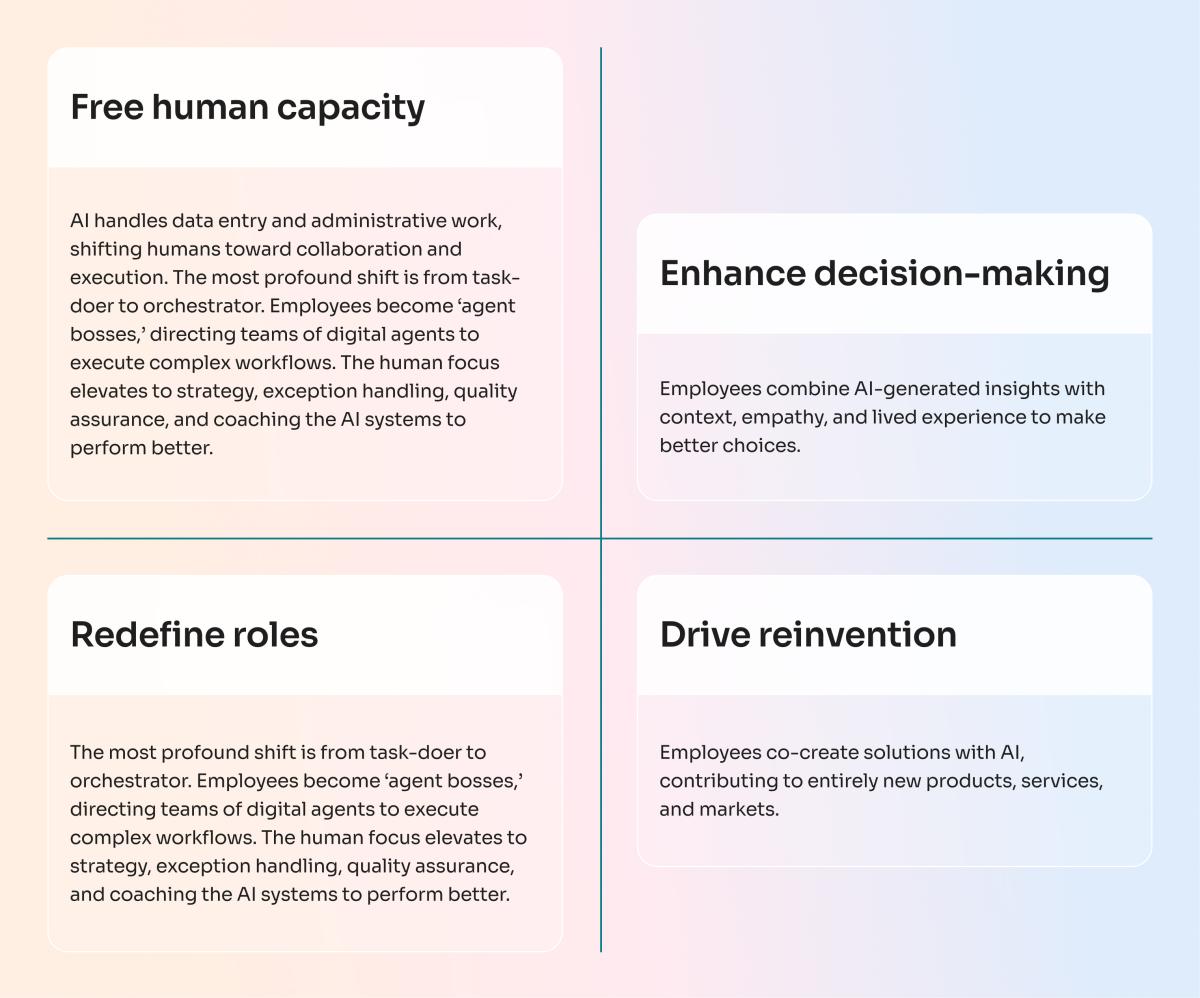
In short, the workforce moves from being task executors to orchestrators of value, a cultural leap as significant as technology itself.
This is not a theoretical shift. A recent survey of global HR executives found that they expect to redeploy nearly a quarter of their workforce as agentic AI is adopted. In preparation, 81% are already planning to reskill their employees, confirming that this transformation is as much about talent strategy as it is about technology.
As organizations accelerate toward Agentic AI, governance becomes the foundation of trust. Responsible AI practices that include transparency, explainability, and ethical use must be built into every phase of adoption.
This governance must directly address the top employee concerns regarding AI agents: the risk of decisions being made without human oversight, unclear accountability when mistakes occur, and the potential for algorithmic bias.
Cross-functional leadership roles such as the CEO, CIO, or CMO, ensure AI investments stay aligned and are not fragmented. This unified oversight connects strategy, workforce, and technology decisions into a coherent framework which accelerates adoption while maintaining compliance and ethical standards.
The business case for Agentic AI is clear. According to Sia's framework, a $1B organization can generate the following ROI at each stage of AI adoption:
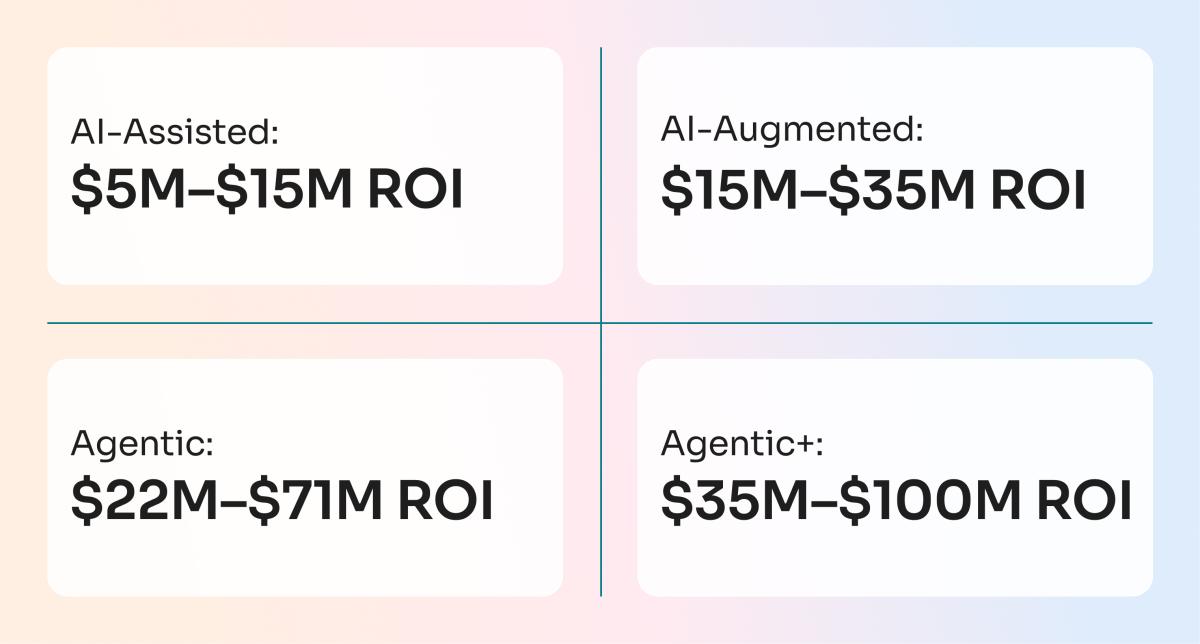
This exponential growth in value is realized because the agentic stages move beyond task automation and unlock full process reinvention, creating new efficiencies and revenue opportunities that were previously impossible.
But these gains are only realized when organizations combine strategic alignment with active workforce engagement. Without people-first integration, AI remains stuck in incremental gains; with it, enterprises unlock exponential value.
The ROI estimates presented are based on a structured, evidence-informed approach combining published research, industry benchmarks, and documented case studies. We used the following steps to calculate ROI:
The four maturity stages (AI-Assisted, AI-Augmented, Agentic AI, Agentic+) were defined based on industry-recognized AI capability frameworks and adoption curves.
For each stage, distinct value drivers were identified (e.g., task, efficiency, decision-making enhancement, human-AI orchestration, business model innovation).
Penetration rate refers to the proportion of addressable work impacted at each maturity stage.
Ranges were derived from large-scale adoption surveys and maturity research using publicly available research from IBM, Deloitte, McKinsey, Gartner and Unilever.
Gains refer to productivity improvement, revenue uplift, or profit impact achievable on the penetrated work.
Gains ranges were informed by empirical research and case studies from publicly available research cited above.
4. ROI Calculation
For each value driver within a stage, ROI % was calculated as: ROI%=Penetration Rate×Raw Gains %
For stages with multiple value drivers (e.g., revenue-facing and productivity gains in Agentic AI), ROI % was calculated for each component separately and summed to produce the total ROI %.
Dollar impact was calculated by multiplying ROI % by the reference company’s annual revenue: ROI$=ROI%×Annual Revenue
The leap to Agentic AI is not defined by algorithms, but by how leaders and employees work together to reshape their organizations. Leadership provides vision and orchestration. Strategy ensures alignment and outcomes. The workforce delivers trust, creativity, and human judgment.
How to Get Started This Week
Together, leaders and employees accelerate AI’s potential from efficiency to reinvention of entire value chains. The leap to Agentic AI starts now: align leaders, set bold outcomes, empower employees as orchestrators, and reskill at speed, because technology won’t transform your business, people will.
If you’re looking for support to ensure your AI and technology work for everyone, leaders and workforce alike, Sia can help you activate these shifts and get results fast.
Partner, Head of Business Transformation, NA | New York
Diana is a Partner at Sia, where she leads the Business Transformation business unit for North America, with over 25 years of experience in business transformation, HR strategy, and change management for Fortune 500 companies.

Partner, US Head of Data & AI | Charlotte
Grayson Blair is an accomplished, award-winning servant leader with 25+ years of consulting and financial services industry experience. Grayson leads the Data and AI consulting services across the U.S.