Digitally Wired: How Distribution System…

The Missing Link Between AI Investment and Workforce Agility

Companies have poured billions into AI—and many still struggle to show meaningful returns.
You’ve read the articles. The problem isn’t the technology. It’s how work gets done.
Most organizations are still structured around jobs, while AI demands something very different: the ability to quickly combine skills, reconfigure teams, and build new ways of working. Skills-based organizations are a step forward—but they’re not enough.
The real unlock for AI ROI is workforce agility.
For decades, work was organized around jobs. You hired a financial analyst, a marketing manager, an HR business partner. Roles were defined, responsibilities were stable, and career paths were predictable.
AI is breaking that model.
Today, even a single business challenge—like improving customer service with AI or modernizing risk management—requires a mix of expertise:
No single job contains all of that.
That’s why organizations are rethinking how work gets done—and how talent is deployed. Organizations that will win will move with speed. To move with speed they need to quickly mobilize to an adaptable workforce structure
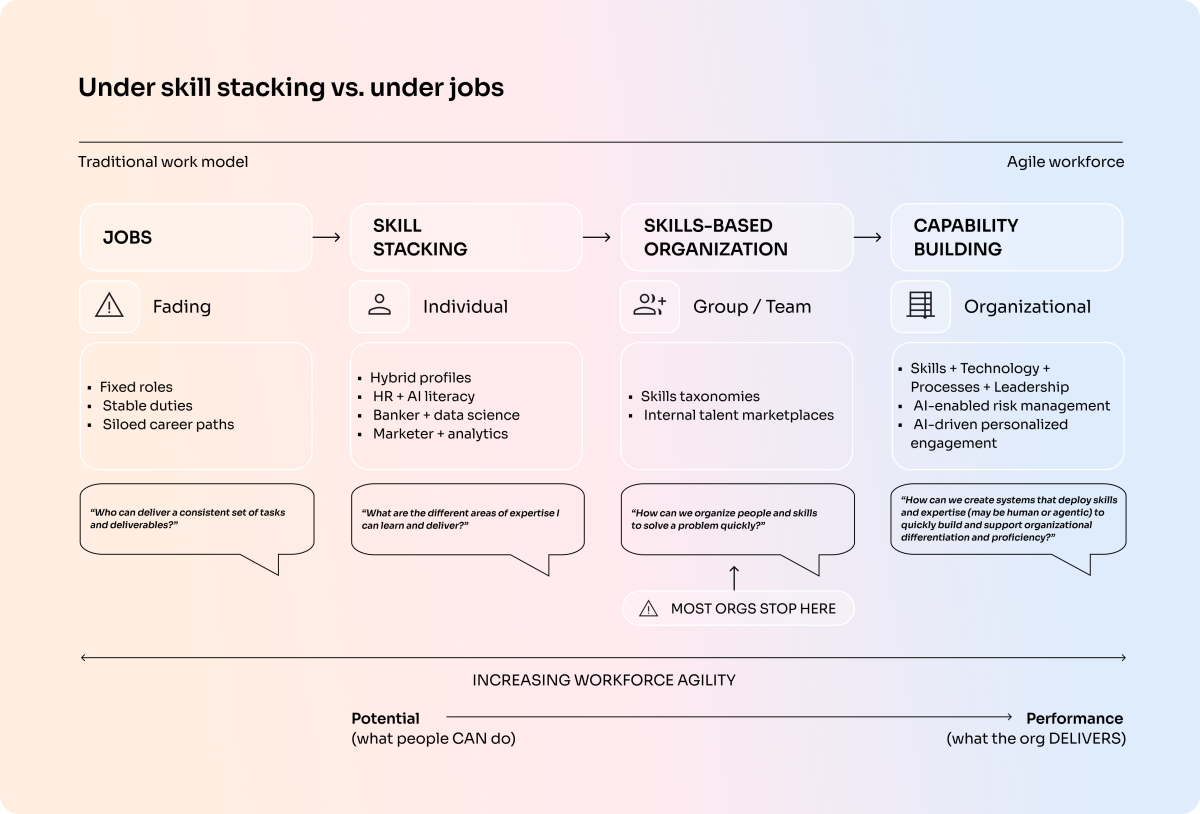
Building Workforce Agility
The first shift happens at the individual level.
People are expanding beyond their core discipline and building “hybrid” profiles:
This kind of skill stacking is valuable. It helps individuals work across boundaries and adapt to new demands. It gives them confidence and helps them feel more marketable within their organization.
But on its own, it doesn’t change how the organization operates.
The next step is structural.
Organizations begin organizing work around skills rather than roles. Many are beginning this shift through:
Instead of asking, “Who owns this job?”, leaders start asking, “Who has the skills to solve this problem?”
This creates more flexibility. Teams can form faster. Work becomes more fluid.
But this is where many organizations stop—and where the connection to AI ROI often breaks down.
Because skills describe what people can do.
They don’t yet define what the organization can, and needs to, deliver.
his is the missing link.
Capabilities are where talent and strategy come together. They combine:
to deliver something the business actually cares about. They drive the differentiation that will drive speed and business outcomes.
For example, an organization might have people skilled in:
But the real value comes when those are brought together into a capability like AI-enabled risk management.
Or take customer experience. You might have strong skills in:
But the outcome that matters is a capability like AI-driven personalized engagement.
Capabilities turn potential into performance.
AI doesn’t create value on its own.
Value comes from the capabilities organizations build with it.
When AI initiatives succeed, it’s not because a new tool was introduced. It’s because the organization learned how to:
That requires workforce agility.
Workforce agility is the ability to:
Skills-based organizations enable this.
Capability building directs it toward real outcomes.
The organizations seeing real returns from AI aren’t just investing more in technology.
They’re better at building and scaling capabilities—faster.
They can move quickly from:
AI experiment → operational capability → business impact
That speed—how fast you can turn ideas into outcomes—is what increasingly defines success.
If workforce agility drives AI ROI, it needs to be measurable.
At its core, it shows up in speed, movement, and alignment. A few practical metrics can make it tangible:
1. Time to Deploy Skills
How long does it take to move the right talent onto a priority initiative?
Signal: Faster staffing = greater agility
2. Time to Capability
How quickly can you turn a pilot into a scaled, operational capability?
Signal: Shorter cycle = stronger execution
3. Talent Redeployment Rate
How frequently are employees moving across teams or projects?
Signal: Higher mobility = more adaptability
4. Cross-Functional Team Formation Speed
How quickly can teams be assembled across silos?
Signal: Less friction = better agility
5. Skill Utilization Rate
Are critical skills being used where they matter most?
Signal: Higher alignment = less wasted capacity
A simple way to think about it:
Workforce Agility ≈ Speed of Deployment × Talent Mobility × Skill Utilization
It’s not a single number—but a set of signals that show how quickly an organization can move from idea to impact.
This shift creates a real opportunity for HR.
The role of HR is evolving—from managing talent to helping build capabilities across the business.
That means helping leaders answer three practical questions:
When organizations can answer those questions well, AI stops being a standalone initiative.
It becomes part of how the business operates.
Skills matter. But on their own, they’re not enough.
The organizations that get the most value from AI will be the ones that can continuously:
The advantage won’t come from having the best technology.
It will come from having the most agile workforce.
Partner, Head of Business Transformation, NA | New York
Diana is a Partner at Sia, where she leads the Business Transformation business unit for North America, with over 25 years of experience in business transformation, HR strategy, and change management for Fortune 500 companies.