Digitally Wired: How Distribution System…

The GCC luxury tourism market is performing well, but three pressures are reshaping the competitive landscape. Our foresight analysis identifies where each market stands and what it would take to strengthen their position.

International tourist arrivals in the UAE, Saudi Arabia and Qatar have reached record highs. Hundreds of billions of dollars are being invested in new developments. Hotel inventory, air capacity, and traveller spend are increasing in line with investment.
However, at exactly the same time there are three forces developing that will determine which of the current destinations retain their relative positions in the GCC luxury tourism space over the next ten years.
The first is generational. Over the course of the next twenty years an estimated $83.5 trillion in wealth is expected to pass from older generations to younger ones. This represents spending power and younger travellers (Millennials & Gen Z) will use this money to visit places that they feel possess some level of cultural authenticity and personal relevance to themselves. While Baby Boomers currently account for most of today's luxury travel spend, the next generation will decide differently. If destinations fail to develop and evolve to meet the expectations of the new generation of travellers and move too slowly, while their competitors develop their offerings to meet the needs of this group, they will ultimately lose customers as those customers form preferences to visit their competitor destinations.
The second is competitive. Saudi Arabia is outspending all other GCC nations on development of tourism infrastructure. The UAE and Qatar are pushing deeper into their existing areas of focus. As a result we now see three countries competing for the attention of the same luxury traveller at the same time. At such times when every player is willing to invest large amounts of capital, then the value proposition is shifted away from how much a destination is prepared to spend and towards what specifically is delivered to the customer.
The third is confidence. Regional conflict has introduced a risk that extends beyond directly affected markets. Luxury travellers have more alternatives than any other segment and shorter decision cycles at the high end. Security perception scores across multiple GCC markets have declined since early 2026. Confidence gaps such as this one do not repair themselves once the underlying cause of tension has disappeared. Past recovery evidence indicates that it is not just when a crisis concludes, but rather how a destination reacts during and after a crisis event that determines how quickly recovery occurs.

Our foresight analysis, built on 53 signals of change mapped across three-time horizons (H1: 2026-2028, H2: 2029-2032, H3: 2033-2040), identifies four demand-based characteristics influencing luxury travellers’ selections of a destination.
Whether a traveller can experience something at this destination that they cannot get somewhere else. Heritage, landscape, and cultural depth that are specific enough to hold pricing power and to bring travellers back.
This factor is gaining strength due to increased competition. All Gulf Cooperation Council countries offer their visitors luxurious accommodations, fine dining experiences, beaches and coastal properties. In order for these factors to function as differentiating attributes among destinations, they need to provide something uniquely available at that location. Examples include AlUla's historical sites, Abu Dhabi's national museums and institutions, Qatar's Museum of Islamic Arts. Each of these destinations provides a type of distinctiveness that would attract the luxury traveller. The destinations that resolve this issue before breaking ground exceed those destinations that wait until they open and attempt to create identity through branding or advertising efforts.
The market has moved past spa as a standard amenity. A full-service spa is now a baseline expectation at most luxury property, comparable to a swimming pool or fitness centre. Its presence no longer drives destination selection or justifies a rate premium.
What is going to drive the decision to go somewhere is credible clinical capabilities. Travellers that choose to spend money on wellness are paying for diagnostic services, evidence-based health protocols, longevity programs and results that have a measurable impact delivered within hospitality environments. With the opening of AMAALA, with Clinique La Prairie, Six Senses, and Equinox we are seeing a clinical wellness model being introduced into the GCC for the first time. Therefore, any new development entering the marketplace after 2026 will be competing against the clinical wellness partnership benchmark that has been established by these luxury brands. The transition from wellness as an atmosphere to wellness as an outcome is not a prediction. We are already witnessing this transition in the pricing power and repeat business generated by luxury hotels and resorts who have transitioned their focus.
Luxury travellers expect more from hotels than they did even one year ago. In addition to what you would normally want prior to arrival such as pre-arrival preferences, loyalty program information etc., travellers expect personalized experiences based upon their current context throughout all aspects of their stay. This type of personalized experience is technologically possible today. What separates your hotel/brand from others in terms of providing personalized experiences is whether or not your brand's hospitality technology platform provides personalized experiences as part of the overall system vs. relying upon individual employees knowing and recalling previous guests' preferences.
Each market in the GCC is experiencing a slightly different version of this issue. While the UAE has the most advanced hospitality technologies deployed in the GCC, traveller data is segmented and resides across multiple platforms including Property Management Systems, Airline Partnerships, Transportation Providers and Experience Operators. Qatar plans to establish a national level of hyper-personalization through the implementation of its Tourism Digital Transformation Roadmap. An Integrated Visitor Application will debut in 2026. Given Qatar's small size geographically and limited number of operators, creating a unified national level of integration may prove easier than in the UAE. Saudi Arabia's developments have an inherent advantage due to the fact that when developing a hospitality property from scratch, there is opportunity for developers to deploy hospitality technology systems that were developed to work together seamlessly. Rather than trying to retrofit hospitality personalization solutions onto legacy systems post-opening. Whether or not this inherent advantage is realized will depend on the inclusion of hospitality personalization architectures in the Master Plan Brief provided to the developer.
Grandparents, parents, and children are travelling together more frequently. The category is growing for reasons that are demographic (longer life expectancy means more generational overlap), cultural (post-COVID family reconnection), and financial (wealthy grandparents funding extended family travel as a form of legacy experience).
The multi-generational travel segment is increasing due to demographics (more generations alive due to increased life expectancy), culture (reconnecting post-pandemic) and economics (generous grandparents financing extended-family travel as a way to create lasting memories). Most luxury hotels/resorts in the GCC offer multi-generational accommodations through various configurations including connecting rooms or villas; however, accommodating multiple generations is different from designing for them. Hospitality operations, food and beverage, activities, wellness, and physical accessibility are generally geared towards couples or single generation families. At present, most luxury properties in the GCC were not designed specifically with three generations in mind at luxury levels. As a result, one of the largest source of demand for luxury accommodations – multi-generational trips – is currently being accommodated through adaptation versus hospitality products specifically designed to meet their needs. The first market to develop hospitality products specifically for multi-generational trips at luxury levels will define the category and receive more high value bookings from multi-generational trips than any other market.
The UAE is the most established luxury tourism market in the GCC with three decades of operational depth across wellness and hospitality infrastructure. The individual assets are strong. What is missing is an integrated proposition that connects them into something a luxury traveller can access and book as a coherent experience.
Saudi Arabia has the largest development pipeline in the region, built entirely on greenfield sites with no legacy constraints. AlUla, in particular, has proven that combining significant archaeological depth with a defined narrative positioning creates a commercial viable luxury tourist destination. The uncertainty lies in whether the remainder of the pipeline completes their cultural identification prior to commencing construction.
Qatar converted World Cup infrastructure into a permanent tourism economy faster than most comparable host nations. Due to its museums (MIA), National Museum etc., Qatar enjoys institutional cultural credibility that very few other GCC destinations can claim. However, the challenge facing Qatar is creating the experiential aspects surrounding its institutions, which would attract and retain luxury travellers for longer periods and encourage repeat visits.
All three markets have identifiable gaps on each dimension. The interventions required to close them differ by market maturity, but the direction is the same, all markets require movement toward specificity from scale.
Three implications emerge from this analysis.
A product built around a single generation is becoming a liability. Destination preferences among millennials and gen z travellers develop quickly and tend to be irreversible. As a result, late-stage repurposing of an existing destination product often occurs after many loyal travellers have shifted their preference elsewhere.
The investment levels have converged across the GCC. Each major Gulf tourism destination is investing large sums of money. Therefore, competitive advantage has been relegated to the specific value propositions offered by each destination across the four demand-side dimensions.
Confidence gaps close through narrative, not through additional investment. In each case reviewed within our analysis, destinations were able to recover more rapidly than others primarily because they could provide credible reasons for a traveller to visit them instead of visiting alternative destinations perceived as "safer."
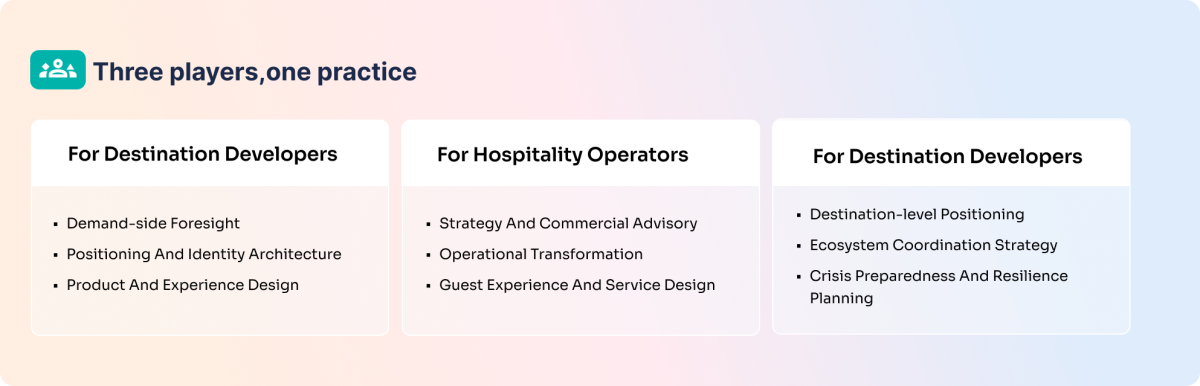
We work with destination developers, hospitality operators, and tourism boards across every dimension of what GCC luxury tourism needs to address right now.
Sources: Sia Analysis | World Wealth Report, 2025 UBS, Global Wealth Report, 2024 Flywire, Unlocking Ultra Luxury Travel, 2025 | WTTC Economic Impact Research 2025 | Tourism Economics / Oxford Economics, March 2026 | Mabrian, March 2026 | Saudi Ministry of Tourism | Qatar Tourism | Dubai DET | Red Sea Global, 2026