Agents Are Becoming The New Interface To Your…

Sia developed the internal model in open-source code and deployed it on Neuroine, replacing a legacy on-premise modelling stack. Four years on, 30+ users across three departments run it 6,000+ times a year.

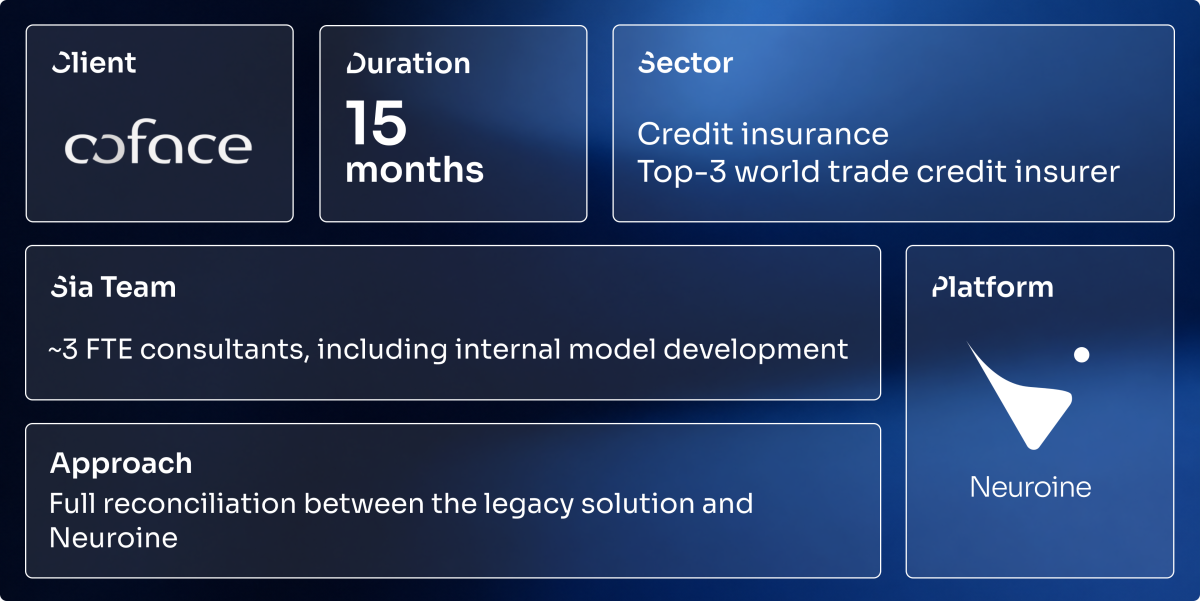
Coface’s internal model ran on a legacy modelling stack: about 800 CPU cores and 500 GB of RAM on premise, with a single run taking around two and a half hours. The IT modelling situation had become critical. At the same time, modelling work was moving to open-source languages outside governed tooling, a shadow IT risk that had to be secured for the regulator.
Coface wanted to move to open source under control, and to become best-in-class and a technological pioneer in its field.
/ Regulatory: the model change had to be accepted by the regulator.
/ Technical: a legacy on-premise stack of ~800 CPU cores to reconcile against.
/ Organisational: four separate modelling tools in use.
In 4 phases, with associated deliverables.

Sia consultants developed the internal model in open-source code to replace the legacy modelling stack, within a team of about 3 FTE over 15 months.

The model was deployed on Neuroine, Sia’s modelling platform, to run and govern it at scale and to cut computation time.

Results from the legacy solution and from Neuroine were fully reconciled, to show that the new model reproduces the results of the old one.

Four years after deployment, the platform serves 30+ users across 3 departments and generates 12+ TB of data every month.
Speed was the first gain. The bigger change is in how teams work: four modelling tools became one platform, and a manual pipeline became a one-click global workflow, with more than 12 TB of data generated every month. Four years after deployment, the project has become a model-driven transformation.
/ Regulatory outcome: Validated by the regulator (ACPR) as a minor model change.
to run the model on Neuroine, down from about 2h30 on the legacy stack.
11 min
model runs a year, up from about 150, 4 years after deployment.
6,000+
users across 3 departments, up from 3, 4 years after deployment.
30+