Destinations Are Investing in MICE Tourism. The…

Articles, podcasts, use cases, research and insights.

The decentralisation of energy markets around the world is accelerating. Its effects are most noticeable in countries where behind-the-meter (BTM) energy generation, in which a business or household produces its own energy, has become entrenched.

Between the summers of 2017 and 2018, long-haul flights between Europe and New York operated by low-cost long-haul airline Norwegian have, for the first time, carried more passengers than those of traditional airline British Airways (1.67 million passengers for Norwegian).

The 2012 “Liborgate” scandal highlighted the limits to this benchmark construction and led to many questioning its reliability. In order to tackle these issues, the European Union approved the “Benchmark Regulation", which came into force in January 2018. How will this affect financial institutions?

Transforming an organisation in order to create winning products and services that customers will grow to love is a constant challenge for most firms. No one wants to be a Walkman in an iPod world!

Air transport stakeholders face a key challenge: the industry forecasts a doubling of air passenger traffic over the next 20 years[1], which airport capacity will not be able to accommodate. At the same time, recent technological innovations have raised travelers’ expectations for a seamless, secure

To meet the steady growth of passenger traffic, there are 2 main solutions for airports: build new terminals
or improve existing ones.

The US withdrawal from the Paris agreement – aiming at fighting climate change and dealing better with its impacts – in June 2017 certainly raised many questions about the future of renewable energy in the country.
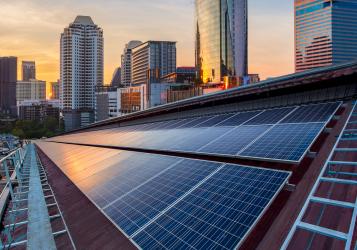
As of 2020, the net-metering mechanism will not be applicable in Brussels anymore for small PV installations. Prosumers (i.e. small PV owners) will therefore have to sell their excess production (mainly from PV installations) at the market price.

The latest studies by the International Air Transport Association (IATA) project a doubling of air traffic by 2025. This growth is driven by the effects of the massive liberalization of the sector since the early 1990s, the growth of low-cost connections and the rapid growth of emerging markets.